

Email Marketing Sales often slow down after a major promotional period for many e-commerce brands. Traffic remains steady, but email revenue quietly tapers off. Engagement drops, campaigns feel less effective, and teams often respond by sending fewer emails instead of fixing the system underneath.
That was the position this client was in at the start of September.
A mid-sized DTC brand with consistent traffic, healthy sales, and Klaviyo already installed. On paper, email should have been performing well. In reality, it was underutilized. The list was growing, but the structure behind it was weak. Key automations were missing or underperforming, segmentation was minimal, and performance was difficult to measure beyond basic metrics.
Over the next four months, we rebuilt their email marketing system with a single goal. Turn email into a predictable and measurable revenue channel instead of an occasional win.
Between September 1, 2025, and January 1, 2026, email generated $208,705.59 in Klaviyo-attributed revenue, accounting for 23.67% of total store revenue, without any increase in ad spend.
Business Performance Overview
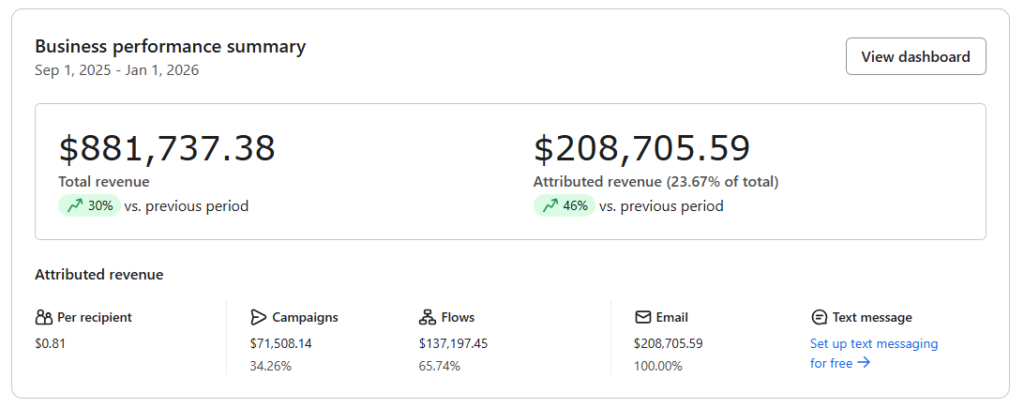
During this four-month period, the brand generated $881,737.38 in total revenue. Of that, $208,705.59 was directly attributed to email inside Klaviyo.
Email revenue increased by 46% compared to the previous period, while overall store revenue grew by 30%.
This confirmed that the email was not just benefiting from overall business growth. It was improving as a channel on its own.

Turn Email Subscribers Into Daily Revenue
We design, automate, and optimize Klaviyo email flows & campaigns that increase repeat purchases, recover lost sales, and scale eCommerce brands predictably.
Where Email Was Underperforming
The brand had an email list in the 10,000 to 15,000 subscriber range. Despite that, the performance told a different story.
Opens were inconsistent, clicks were low, and large portions of the list were not being monetized at all.
A full audit of their Klaviyo account revealed several gaps.
- Campaigns were sent inconsistently, with no clear cadence
- Most revenue depended on campaigns, not automation
- Key flows, like abandoned cart and browse abandonment, were underutilized
- Pop-ups converted modestly but weren’t optimized
- Testing was minimal, and decisions were largely instinct-driven
Email wasn’t broken, but it wasn’t designed to scale either.
Rebuilding the Email Marketing Sales System in Klaviyo
Instead of chasing short-term wins, we focused on building a solid foundation first. The priority was to let automation handle high-intent moments and use campaigns more intentionally.
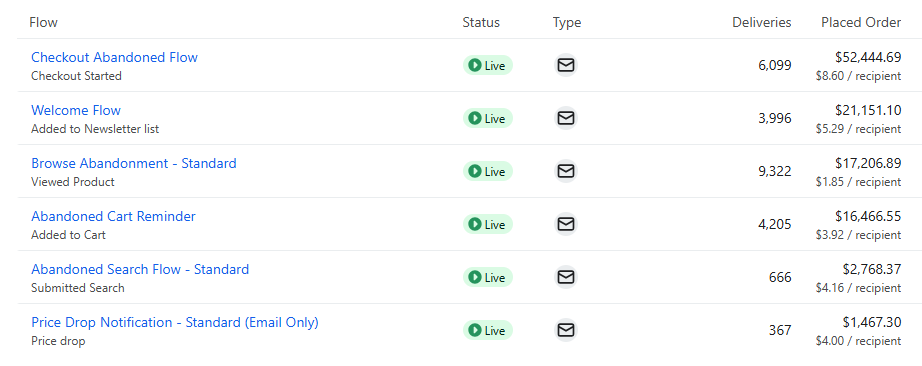
Over the four-months, automated flows became the primary revenue driver.
Flow-First Strategy
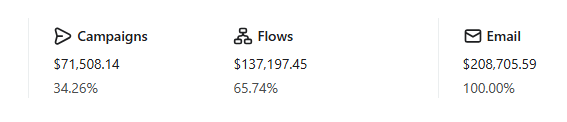
- Flows generated $137,197.45
- 65.74% of total email-attributed revenue
Key flows implemented and optimized included:
- Welcome Series focused on first-purchase conversion
- Abandoned Cart flow with timing and product-level personalization
- Post-Purchase flow encouraging repeat purchases and cross-sells
- Browse Abandonment flow to capture high-intent visitors
- Win-back flow targeting inactive but previously engaged subscribers
Each flow was tested, refined, and timed based on subscriber behavior, not assumptions.
Result:
Campaigns With a Clear Purpose
Once flows were in place, campaigns were no longer responsible for carrying the entire revenue load.
Campaign performance during this period:
- $71,508.14 attributed to campaigns
- 34.26% of total email revenue
- $0.81 revenue per recipient, indicating efficient list monetization
Campaigns were segmented by engagement level, purchase behavior, and intent. Instead of blasting the full list, each send had a clear audience and objective product launches, seasonal pushes, or behavioral follow-ups.
The result was steadier performance, better engagement, and less reliance on discounts.
How Data Guided Every Decision
Performance was not judged by open rates alone. We focused on revenue at the flow, campaign, and recipient level inside Klaviyo.
The data showed that automated flows consistently outperformed campaigns in revenue efficiency. Certain segments responded better to timing changes than to additional incentives. High-intent subscribers drove a disproportionate share of revenue when messaged correctly. Small improvements in subject lines and flow timing compounded over time.
Tracking revenue per recipient and flow contribution made optimization decisions clearer and easier to prioritize.
The Role of Testing (Without Overcomplicating It)
Testing wasn’t treated as a one-off experiment. It was part of the system.
We tested:
- Subject line variations across campaigns
- Flow timing delays and message order
- CTA placement and language
- Offer visibility versus education-led emails
Not every test produced a breakthrough. Some delivered marginal gains. Others quietly underperformed and were rolled back. Over time, those small adjustments added up to consistent growth without increasing send volume or ad spend.
Results in Context
By January 1st, email had become a reliable revenue engine rather than a supporting channel.
Email impact summary:
- $208,705.59 in Klaviyo-attributed revenue
- 23.67% of total store revenue is driven by email
- 46% growth in email revenue vs the previous period
- 65.74% of email revenue generated by flows
This wasn’t driven by one campaign or a single promotion. It was the result of system-level improvements working together.

Get All-in-One AI Automation
Voice AI, WhatsApp, Chatbots & Smart Workflows, All in one platform. Get more customers, save time, and scale effortlessly.
What This Demonstrates
Email does not need louder sends or heavier discounts to perform. It needs structure.
When pop-ups attract the right subscribers, flows capture intent automatically, campaigns are targeted with purpose, and decisions are guided by data, email becomes predictable and scalable.
Even with a moderately sized list, email can contribute a meaningful share of total revenue when the system behind it is built correctly.
Who This Approach Works For
This approach is best suited for brands with steady traffic and underperforming email revenue, teams already using Klaviyo but relying heavily on campaigns, and businesses looking for sustainable growth rather than short term spikes.
Email performs best when it is designed to run continuously instead of reactively.