
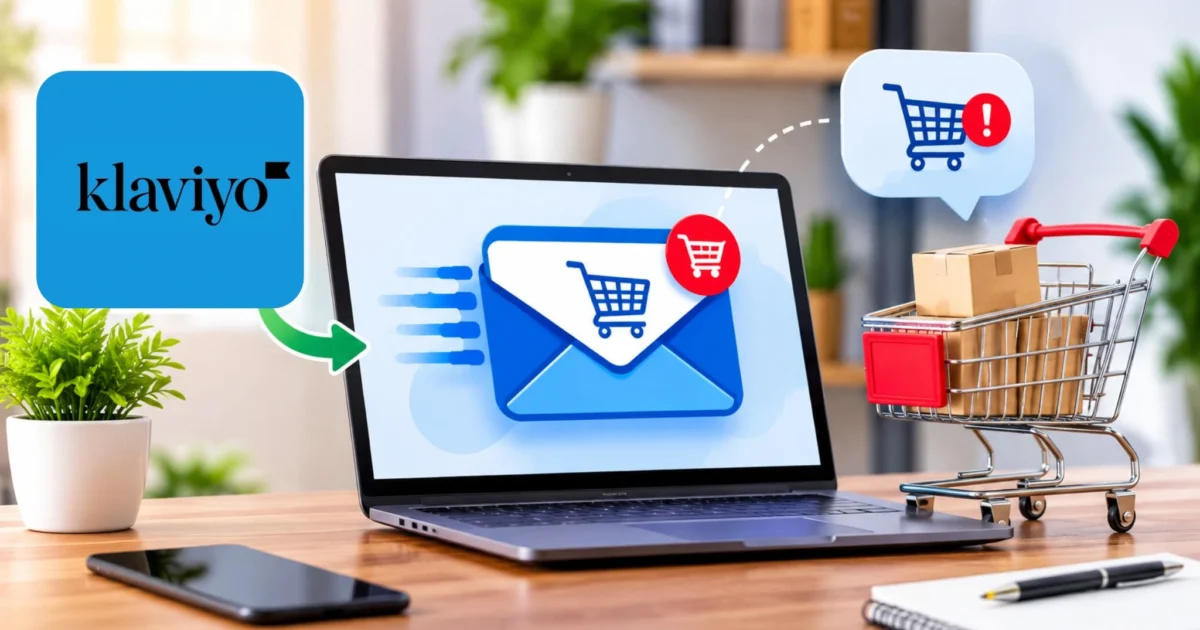
A Klaviyo abandoned cart email is the closest thing e-commerce has to a second chance. Someone added to cart and left. Here’s how to bring them back.
The scale of the problem is large. Baymard Institute’s average across 50 studies puts online cart abandonment at 70.22%. Many of those shoppers were only browsing, but a real share were ready to buy and got interrupted by a phone call, a surprise shipping cost or a toddler. Those are the people your emails can win back.
This guide gives you seven Klaviyo abandoned cart email examples you can copy, the timing that fits each one, a step-by-step setup, and the mistakes I see most often when brands build these flows.

What Should a Klaviyo Abandoned Cart Email Say?
A good Klaviyo abandoned cart email reminds the shopper what they left behind, shows the exact items with a clear button back to checkout, and answers the most likely hesitation, such as shipping cost, returns or sizing. Send the first one within an hour, follow up over several days, and stop the moment they buy.
Key Takeaways
Essential tactics to turn abandoned carts into recovered revenue without sacrificing profit margins.
1. Build a Multi-Email Sequence
2. Give Each Email a Unique Purpose
3. Dynamic Cart Product Visuals
4. Protect Your Profit Margins
5. Flow Logic & Mobile Optimization
6. Measure What Actually Matters
How Does a Klaviyo Abandoned Cart Flow Work?
A flow is a set of automated emails that starts when a shopper does something specific. In Klaviyo, the trigger is usually Added to Cart or Checkout Started, depending on your store platform and how early you want to reach people. Once triggered, the Klaviyo abandoned cart email sequence waits, sends, and exits the shopper if they place an order.
Here’s the timing structure I’d start with. Treat it as a starting point and adjust to your buying cycle.
Abandoned Cart Email Timeline
A strategic schedule of when to send each flow email and what specific job it performs.
| When to Send | Job / Purpose | |
|---|---|---|
| 1 | About 1 hour after abandonment | Simple reminder |
| 2 | About 24 hours | Answer objections |
| 3 | Day 2 | Social proof |
| 4 | Day 3 | Help or honest urgency |
| 5 | Day 4-5 | Final call, with an incentive if you use one |
A lower-priced impulse product can use a shorter sequence. A higher-priced item, like furniture or a premium appliance, benefits from a longer one because people research before they buy.
Why Do Shoppers Abandon Carts in the First Place?
You can’t write good cart recovery emails without knowing why people leave. The common reasons are:
- Unexpected costs. Shipping, taxes or fees show up late. Baymard’s research consistently lists this among the top reasons.
- Just browsing. They never intended to buy today.
- Forced account creation. Guest checkout removes the friction.
- A long or confusing checkout. Too many steps, too many fields.
- Trust questions. Return policy, delivery time, whether the brand is legitimate.
Your emails can’t fix a broken checkout, but they can answer the doubt that made someone pause. That’s why the examples below each target a different objection.
Want a second set of eyes on your flow? If your abandoned cart emails are live but not producing sales, we’ll review them with you. Our team builds and audits ecommerce flows as part of our Klaviyo email marketing services and can show you where revenue is slipping out.
7 Klaviyo Abandoned Cart Email Examples to Copy
Every Klaviyo abandoned cart email below is a template. Replace the brackets with your own details and rewrite the wording so it sounds like your brand. Use Klaviyo’s dynamic product block to show the items in each shopper’s cart. If you’re looking for Klaviyo flow templates to start from, these seven map neatly onto Klaviyo’s built-in abandoned cart flow.
Example 1: The Friendly Reminder (about 1 hour)
Abandoned Cart Reminder Sequence
A live structural example of the first email sent roughly 1 hour after abandonment.
Hi {{ first_name|default:“there” }},
Looks like you didn’t get to finish checking out. No rush, your items are saved.
Questions about sizing, shipping or anything else? Just reply to this email and we’ll help.
Why it works: The first email is a nudge, not a pitch. Most people who left by accident come back after seeing their items. No discount here. A Klaviyo abandoned cart email this early should feel like a helpful receipt, not an ad.
Example 2: The Objection Handler (about 24 hours)
Objection Handling Email Sequence
Sent roughly 24 hours after abandonment to answer common shipping and return questions.
Hi {{ first_name|default:“there” }},
If you’re still deciding, here’s what customers usually ask us:
Why it works: People rarely say “I’m leaving because of your return policy.” They just leave. This email answers the unspoken question before they have to ask it. Use your real policies and keep it short.
Example 3: The Social Proof Email (day 2)
Social Proof Email Sequence
Sent roughly 48 hours after abandonment to build trust using authentic customer reviews.
Hi {{ first_name|default:“there” }},
Not sure yet? Here’s what other customers say about [Product Name]:
“[Real customer review, with permission — e.g., ‘Best quality item I’ve purchased this year. Arrived super fast and exceeded expectations!’]”
Why it works: Trust is a common reason for hesitation, especially for newer brands. Use only genuine reviews you have the right to share. Never invent testimonials, because shoppers can tell, and it can create legal trouble. This Klaviyo abandoned cart email is especially strong for products people feel nervous about ordering online.
Example 4: The Honest Low-Stock Email (day 3, only if true)
Scarcity & Urgency Email Sequence
Sent roughly 72 hours after abandonment to encourage action on low-stock items.
Hi {{ first_name|default:“there” }},
The [Product Name] in your cart is running low. We’d hate for you to miss it.
Why it works: Scarcity motivates when it’s real. If stock isn’t actually low, skip this email. Fake urgency damages trust, and your customers will notice the next time they see the same “only 2 left” message. A Klaviyo abandoned cart email built on false claims costs you more than it earns.
Example 5: The Helpful Human Email (day 3-4)
Personal Help & Concierge Outreach
A high-touch support email designed to remove last-minute buying hesitation.
Hi {{ first_name|default:“there” }},
I’m [Name] from [Brand]. I noticed you were looking at [Product Name]. If you have questions about [fit / ingredients / compatibility], just hit reply and I’ll answer personally.
Why it works: A short, plain-looking message from a named person feels different from a promotion. It suits higher-priced or complicated products where a question is the real blocker. Make sure someone actually monitors the reply inbox.
Example 6: The Incentive Email (day 4-5, optional)
Incentive & Discount Sequence
Sent in the final stage (Day 4–5) to close price-sensitive cart abandoners.
Hi {{ first_name|default:“there” }},
We saved your cart and added a little something. Use the code below for [10% off] your order:
Why it works: Some shoppers just need a nudge on price. Save the discount for late in the sequence so you don’t give margin away to people who would have bought anyway. Test whether free shipping works better than a percentage for your margins. This is the Klaviyo abandoned cart email I’d test most carefully, because a discount changes your profit per order.
Example 7: The Final Call (last email)
Cart Expiration & Last Chance Sequence
The final graceful reminder before cart reservation logic expires.
Hi {{ first_name|default:“there” }},
This is our last note about the items in your cart. If you’re ready, they’re one click away. If not, no hard feelings.
Why it works: A clear, polite ending respects the shopper and often prompts a final decision. After this email, let the flow end. Over-mailing someone who has said no through silence mostly raises unsubscribes.
Running ecommerce and service sales together? Klaviyo is the stronger tool for store-based email flows. But if you also want SMS follow-up, a built-in CRM, missed-call text-back and review requests in one platform, GoHighLevel is worth a look. We offer a 30-day free trial of GHL. Start your free GHL trial.
How to Set Up a Klaviyo Abandoned Cart Email Flow
- Connect your store. Make sure your ecommerce platform is integrated so Klaviyo can see cart and checkout events.
- Start from the template. In the flow library, open the abandoned cart template. It gives you a working structure to edit.
- Choose the trigger. Decide between Added to Cart and Checkout Started. Checkout Started targets more serious buyers. Added to Cart reaches more people.
- Confirm the exit rule. The flow should stop once someone places an order. Klaviyo’s template includes this, but check it before you launch.
- Add your emails and delays. Use the timing table above as a starting point.
- Insert the dynamic product block. This pulls each shopper’s actual items into the email.
- Preview on mobile. Many opens happen on phones, so check buttons, images and line length.
- Test before launch. Run a test purchase and cart abandonment yourself, confirm the right emails arrive in the right order, then switch the flow live.

Common Mistakes to Avoid
- Sending only one email. A single Klaviyo abandoned cart email catches only the fastest decision-makers. Build a sequence.
- Leading with a discount. It cuts margin and teaches shoppers to abandon on purpose. Reserve it for late in the flow.
- Hiding the cart contents. If the shopper can’t see what they left, the email feels generic.
- Ignoring mobile design. Tiny buttons and heavy images lose clicks.
- Letting the flow keep sending after a purchase. Nothing annoys a new customer faster. Test the exit logic.
- Using fake urgency or fake reviews. It may lift one campaign, but it weakens trust over time.
- Never testing. Subject lines, timing and incentives all deserve A/B tests. Even good cart recovery emails improve with testing.
How to Measure Whether Your Flow Is Working
Open rates are a weak guide, partly because email privacy features can inflate them.
Focus on:
- Placed order rate: how many recipients buy.
- Revenue per recipient: the best single number for comparing versions.
- Click rate: shows whether the message and button are working.
- Unsubscribe rate: a warning sign if the sequence is too long or too pushy.
Review each email separately. If email 3 underperforms, rewrite that one rather than rebuilding everything. Measure the whole Klaviyo abandoned cart email sequence over a few weeks, not a few days, so you have enough orders to see real patterns.
Final Thoughts
The best Klaviyo abandoned cart email isn’t clever. It’s timely, it shows the product, and it answers the doubt that made the shopper leave. Build a short sequence, give each email one job, keep discounts for the end, and review the numbers before you change anything.
If you’d rather have experts build it, talk to our Charlotte team. We’ll review your current flow, show you where sales are leaking, and map the next steps. And if you want SMS, a CRM and review automation alongside your email, start your 30-day free GoHighLevel trial.